

Do you experience persistent shoulder discomfort, or have trouble raising your arm or performing certain everyday tasks? You’re not alone. A rotator cuff tear is one of the most common causes of shoulder pain, especially after age 50. This article will help you understand this condition, learn how it’s diagnosed, explore treatment options, and discover how to adjust your rest periods to feel more comfortable, both day and night.
Rotator Cuff Tear: A Quick Overview and Key Points
The rotator cuff is a group of four muscles and their tendons—the supraspinatus, infraspinatus, teres minor, and subscapularis—that surround the head of the humerus like a sleeve. The rotator cuff stabilizes the shoulder and enables most shoulder movements, such as raising the arm, rotating it, and reaching for an object overhead. The tendons of the rotator cuff hold the head of the humerus in place within the joint, facing the scapula, ensuring the stability and mobility of this complex joint.
When we talk about a tear, we are referring to a partial or complete tear of one or more of these tendons. The supraspinatus tendon is most commonly affected, due to its anatomy and its position, which makes it particularly vulnerable to subacromial impingement.
This blog post is provided for informational purposes only and is in no way a substitute for medical advice, diagnosis, or treatment by a healthcare professional.
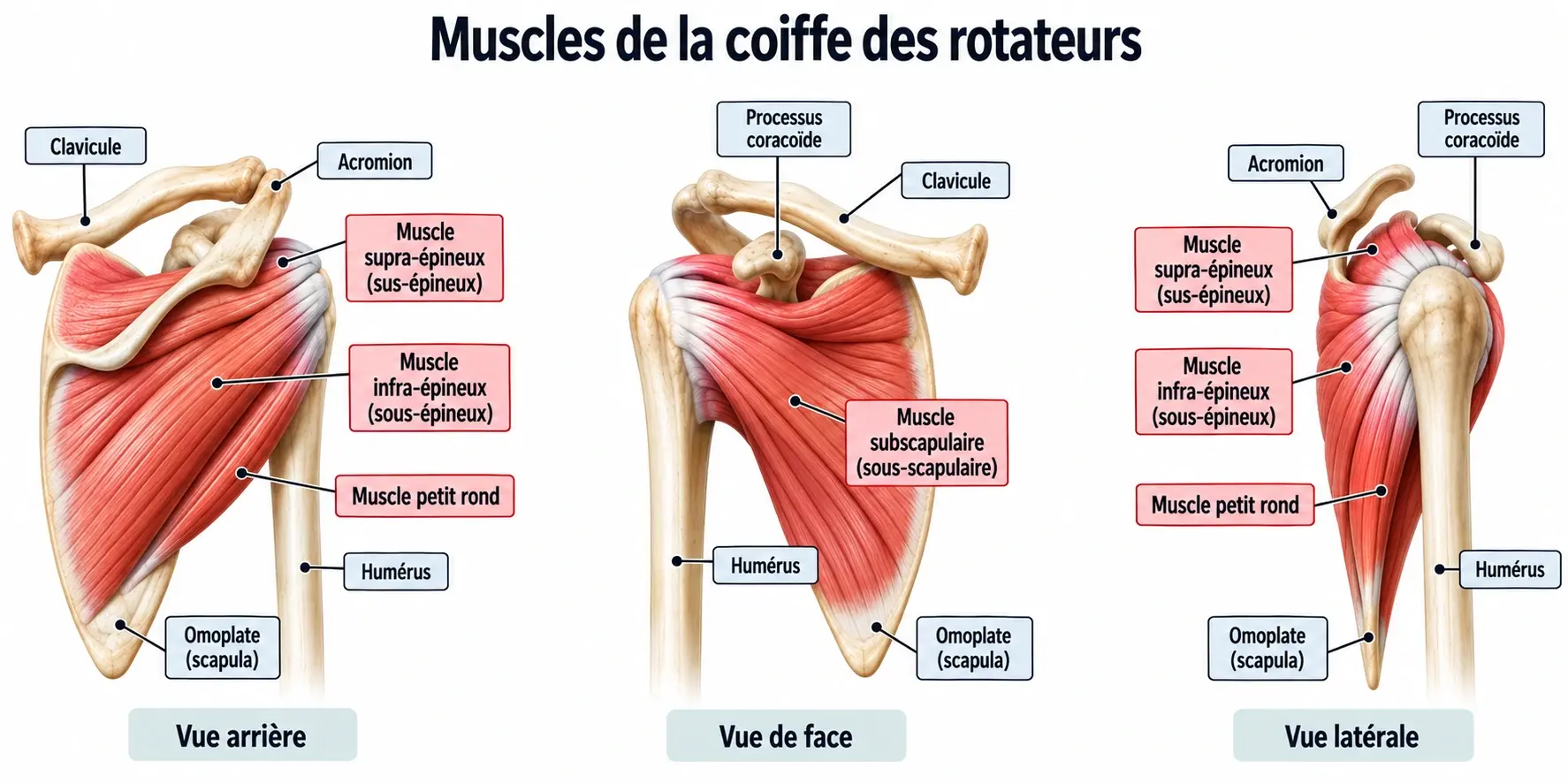
The Two Main Categories of Disruption
Tears can be degenerative or traumatic. Here's what sets them apart:
Acute Traumatic Rupture | Progressive degenerative tear | |
|---|---|---|
Origin | A fall, a sports injury, or a sudden, violent movement | Gradual wear and tear on the tendons, aging |
Typical age | All ages | After 50–60 years in most cases |
Appearance | Sudden, often following a specific traumatic event | Progressive, sometimes silent at first |
Background | The tendon mayhave been healthy before the accident | Pre-existing conditions, metabolic factors |
Factorssuch as repetitive overhead movements, certain occupational or athletic activities, and the natural aging of tendon tissue increase the risk of a rotator cuff tear. Shoulder pain is common with age: according to the Haute Autorité de Santé (HAS), rotator cuff conditions (tendinopathies and tears) account for approximately two-thirds to 70% of shoulder pain in adults [1][5].
The Main Functional Signs
Shoulder pain is the most common symptom of a tear. It typically occurs in the shoulder joint, sometimes radiating down the arm. But pain isn’t the only sign:
- Limited range of motion: Limited range of motion can make it impossible to actively raise the arm, especially above shoulder level.
- Loss of strength: Loss of muscle strength makes it difficult to perform everyday tasks such as combing one's hair or carrying an object.
- Difficulty performing daily activities: getting dressed, holding onto a handrail, reaching a shelf.
- Nighttime discomfort: Pain is often worse at night, especially when lying on the affected side.
A tear can result in a significant loss of active range of motion, even though passive range of motion may remain normal. This is a sign that the doctor looks for during the clinical examination; rehabilitation will focus on maintaining shoulder mobility.
Key Points to Remember About Treatment
Rest assured: not all tears require surgery. The rotator cuff can remain partially functional even after a tear, depending on the extent of the injury and which tendons are affected. The diagnosis and treatment plan are determined by the doctor—a primary care physician, rheumatologist, or orthopedic surgeon—who evaluates each case individually.
One striking statistic clearly illustrates the prevalence of this condition: The incidence of rotator cuff injuries increases significantly with age. In fact, up to 60% of people over the age of 80 have a rotator cuff tear, often without any noticeable clinical symptoms [2]. This means that many people live with a tear without knowing it, as their shoulder retains acceptable function in daily life [6].
To make an accurate diagnosis, the doctor relies on a clinical examination, supplemented as needed by imaging tests: X-rays, ultrasound, MRI, or arthroscan. This is the subject of the following section.
Diagnosis and Medical Management of Rotator Cuff Tears
The process begins with a medical consultation. The diagnosis is then refined through additional tests if necessary, and a treatment plan is developed step by step, based on each patient’s individual situation.
Clinical Examination and Initial Assessment
The diagnosis begins with a physical examination of the shoulder. This first step is essential and consists of several parts.
The interview allows the doctor to understand the context:
- Was there a specific injury (a fall, a blow, or a forceful movement), or did the pain develop gradually?
- What activities cause discomfort in daily life?
- What is your occupation, and how active are you in sports?
- How long have the symptoms been present?
The physical examination includes:
- Palpation of the shoulder and surrounding muscle areas.
- Assessment of passive and active ranges of motion: abduction, external and internal rotation, and arm elevation.
- Specific rotator cuff tests—such as the Jobe test for the supraspinatus and the Gerber test for the subscapularis—can help identify the affected tendon or tendons.
- Comparison with the opposite side to objectively assess a deficit in strength or mobility.
A neurological examination is recommended for persistent pain to rule out nerve damage in the upper limb. The doctor also examines the cervical spine, as certain conditions affecting the cervical spine can cause referred pain in the shoulder, which is sometimes mistaken for rotator cuff syndrome.
Imaging Tests
When a clinical examination suggests a rotator cuff tear, imaging tests are used to confirm the diagnosis.
Standard X-rays
X-rays of the shoulder (anterior view in neutral rotation, lateral view) are often the first test ordered. They do not directly show the tendons, but they allow for:
- To treat glenohumeral osteoarthritis.
- To detect tendon calcifications (often associated with calcific tendinitis).
- To identify excessive eccentricity of the humeral head, an intermediate sign suggestive of a previous massive fracture.
Ultrasound
Ultrasound is used to detect tendon ruptures. It is a common first-line test when a trained professional is available. It allows for:
- Directly visualize the rotator cuff tendons.
- Identify a partial or through tear and assess the tendon thickness.
- Detect associated bursitis.
Its advantage: it is accessible, radiation-free, and less expensive than an MRI.
MRI and Arthroscan
An MRI and/or arthroscan are recommended for tears that require surgery. These tests provide a detailed assessment of:
- The exact size of the tear and the number of tendons affected.
- Tendon retraction and muscle quality (atrophy, fatty infiltration—essential prognostic factors).
- Associated injuries (labrum, cartilage, long biceps tendon).
Principles of Care
Treatment is always tailored to the individual. Age can influence the type of treatment recommended for a rotator cuff tear, as can activity level, height, how long ago the tear occurred, and the extent of functional impairment.
Medical-Functional Treatment: The First Step
Non-surgical treatments include rest and physical therapy. More specifically:
- Relative rest for the shoulder: adapting daily activities, limiting painful movements, without prolonged strict immobilization.
- Pain relievers (primarily acetaminophen) and anti-inflammatory medications as needed, under a doctor's supervision.
- Targeted physical therapy: progressive exercises to maintain mobility and strengthen the deltoid, the periscapular muscles, and the remaining rotator cuff. Gentle mobilization, starting with passive mobilization and progressing to active-assisted mobilization, is tailored to each individual’s situation [7]. This rehabilitation is supervised by a physical therapist, who supplements it with a program of exercises to be performed independently.
Physical therapy is generally recommended as the first-line treatment for degenerative tears. A conservative medical approach is recommended for wear-and-tear injuries, particularly when symptoms remain moderate. Sedentary individuals often prefer conservative treatment if symptoms remain moderate, while highly active individuals may have different functional expectations.
Location of Infiltration
Corticosteroid injections into the subacromial space may be considered if symptoms persist after several weeks of proper treatment. Some important precautions:
- Limited number of infiltrations.
- There must be at least a three-week interval between two injections.
- Injections are never a substitute for physical therapy, which remains a central component of treatment. [1]
Not all fractures require surgery
This point is worth emphasizing. Many degenerative tears that cause few symptoms can be monitored and managed conservatively. Surgery may be considered after at least six months of properly administered medical and functional treatment if discomfort or pain persists. However, if conservative treatment fails or functional impairment worsens, the orthopedic surgeon’s opinion becomes essential.
Surgical Indications
Surgery is considered in several situations:
- Recent traumatic rupture: A recent traumatic rupture often warrants prompt surgical evaluation, especially when it involves a previously healthy tendon in an active individual. Surgery may be necessary in cases of traumatic rupture accompanied by significant loss of strength.
- Persistent discomfort despite proper treatment over several months, in active and relatively young individuals .
Arthroscopy is the gold standard for rotator cuff repair. Less invasive than open surgery, it allows for tendon repair with a generally more favorable recovery time. Acromioplasty may be performed in conjunction with it, depending on the patient’s anatomy and current clinical guidelines. Recovery after surgery can take up to a year, with gradual, supervised rehabilitation.
In certain cases of irreparable tears—such as extensive, long-standing injuries with severely retracted or infiltrated muscles—other treatment options are available: arthroscopic debridement, tendon transfers, or, if the condition has progressed to osteoarthritis (eccentric omarthrosis), a reverse shoulder arthroplasty. These options are discussed on a case-by-case basis with the surgeon.
Transition to Daily Life
In addition to medical treatment—whether conservative or surgical—managing daily activities, rest, and especially sleep plays an important role in shoulder comfort. This is a topic that many patients discuss with their doctor or physical therapist, and it deserves special attention.
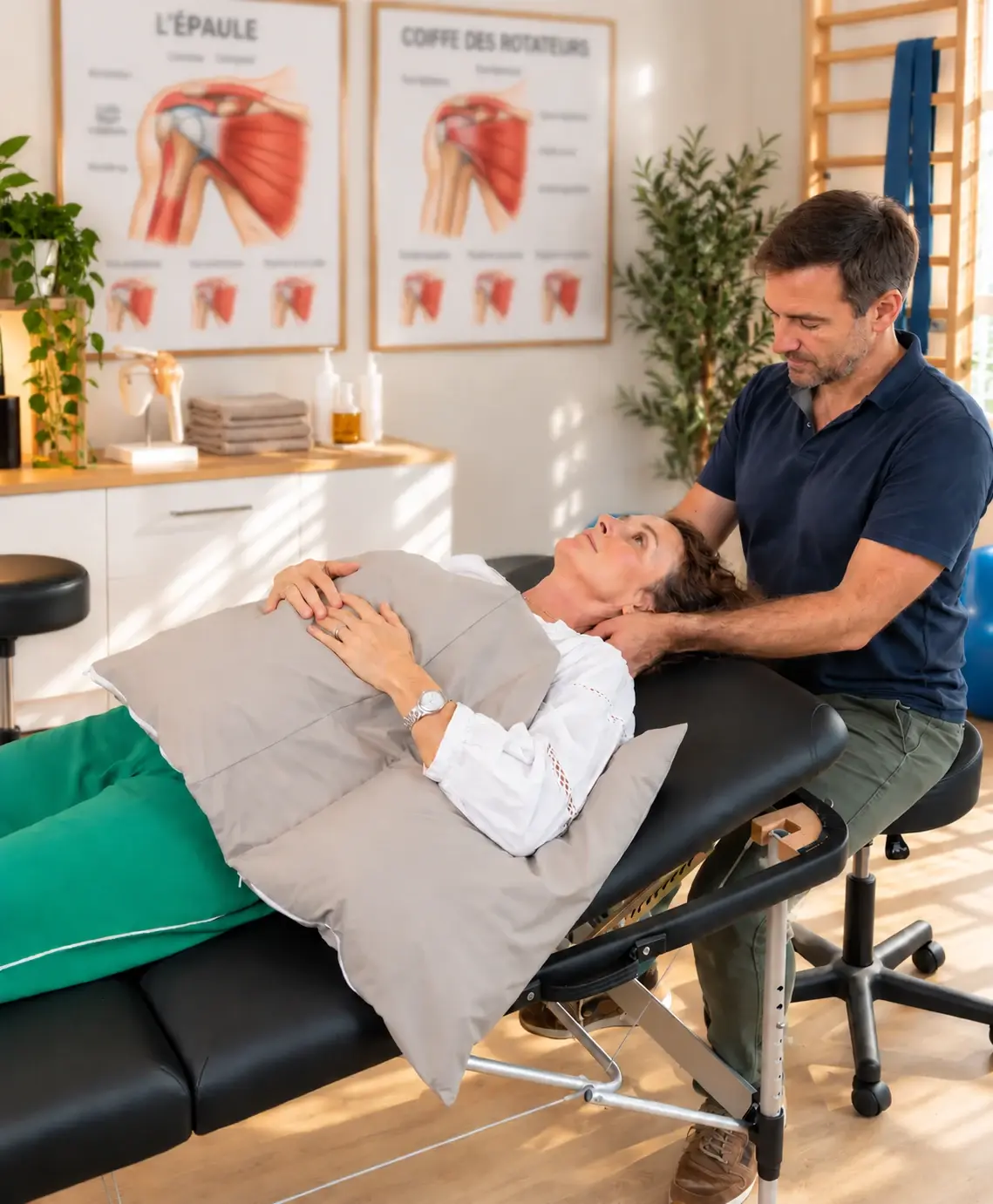
Rotator Cuff Tears, Sleep, and Comfort: Nighttime Posture and the Role of an Ergonomic Pillow
Many people report shoulder discomfort at night, particularly when lying on their side. Adjusting one’s sleeping position can help improve comfort, regardless of any other medical decisions that have been made (rehabilitation, surgery, follow-up care). Nighttime shoulder discomfort is a common complaint among patients.
Why is sleep often uncomfortable when you have a rotator cuff problem?
During the day, gravity pulls the arm downward, which reduces pressure on the inflamed structures in the subacromial space (decompression effect). At night, this is no longer the case.
Whilesleeping, certain positions place additional strain on the shoulder joint :
- On the side: Prolonged pressure on the shoulder can increase local discomfort and worsen symptoms in some people.
- On the back: the unsupported arm may “hang” slightly, creating passive tension on the weakened tendons.
- On the stomach: forced internal rotation of the shoulder increases stress.
This leads to very real-life situations: trouble finding a comfortable position, waking up at night due to shoulder discomfort, and difficulty turning over in bed without triggering pain. Over time, these sleep disturbances affect overall well-being.

General Positioning Recommendations
The French National Health Insurance recommends resting your arm on a pillow if you experience shoulder discomfort at night. This simple step—placing a pillow under your forearm and/or arm while lying on your side or on your back—helps minimize uncomfortable positions.
Some examples of positioning:
- In the supine position: a pillow placed under the forearm, with the arm slightly away from the body.
- In the lateral recumbent position (on the unaffected side): place a pillow between the arm and the chest so that the arm on the affected side rests without sagging.
Includes an ergonomic shoulder pillow for times of rest
Shooldy, the first ergonomic shoulder cushion designed by healthcare professionals, is based on this concept of comfort and proper alignment. Its shape is designed to conform to the contours of the arm and shoulder, providing stable yet gentle support tailored to different body types.
Shooldy is a comfort and wellness product. It is not a medical device. It does not treat rotator cuff tears, but is designed to provide comfort during rest—at night, during a nap, while reading, or during moments of relaxation.
The French National Health Insurance recommends sleeping on your back or on the side opposite the painful shoulder and, if necessary, resting the affected arm on a pillow placed under the forearm to improve comfort during the night [4]. Shooldy was designed to facilitate this type of positioning thanks to its shape, adaptability, support, and light weight.
This distinction is important: the institution provides a general recommendation regarding posture. Shooldy offers an ergonomic cushion that can support this posture, without replacing medical advice or care.
Comfort, Mobility, and Practical Applications
Beyond bedtime, the Shooldy pillow fits into many different aspects of daily life:
- Placed on the side, between the arm and the chest, to provide comfortable support and prevent the arm from sagging toward the mattress.
- On the back, slipped under the forearm and arm for comfortable support and even weight distribution.
- On the couch or in a semi-seated position, to enhance a moment of reading, relaxation, or rest by relieving the constant pull of the arm’s weight on the cervical region.
- On the go: Its lightweight design makes it easy to take along on weekend trips, vacations, or short stays, so you can enjoy your usual comforts.
The goal is to provide a gentle touch, a light, enveloping feel, and subtle support that adapts to your body shape without feeling restrictive. If you roll over during the night, the pillow moves easily with you.
In summary
Rotator cuff tears are a common condition that affects many people to varying degrees. Some tears require surgery, while others can be managed with physical therapy and adjustments to daily activities. In all cases, the precise diagnosis and treatment plan are determined by the entire healthcare team working with you—your doctor, physical therapist, and orthopedic surgeon.
In addition to this medical care, adjusting how you organize your days—and especially your nights—choosing a more comfortable sleeping position, and using a specialized ergonomic pillow like Shooldy can help create a more comfortable sleeping environment and make it easier to follow certain recommendations for nighttime positioning. However, this type of accessory is not a substitute for medical evaluation, physical therapy, or prescribed treatments when they are necessary.
Suggested Scientific Bibliography
French Recommendations
[1] Haute Autorité de Santé (HAS).
Diagnostic Approach to Non-Traumatic Shoulder Pain in Adults and Management of Rotator Cuff Tendinopathies.Best Practice Recommendations. 2023.
[3] Haute Autorité de Santé (HAS).
Management of rotator cuff tears: the role of surgery.Best practice recommendations. 2026.
[4] Health Insurance (ameli.fr).
How can you relieve shoulder pain on a daily basis?Recommendations for positioning a painful shoulder at night.
International Scientific Articles
[2] Minagawa H, Yamamoto N, Abe H, et al.
Prevalence of symptomatic and asymptomatic rotator cuff tears in the general population.Journal of Shoulder and Elbow Surgery. 2013;22(1):e1-e12.
[5] Teunis T, Lubberts B, Reilly BT, Ring D.
A systematic review and pooled analysis of the prevalence of rotator cuff disease.Journal of Shoulder and Elbow Surgery. 2014;23(12):1913-1921.
[6] Safran O, Schroeder J, Bloom R, et al.
Natural history of symptomatic rotator cuff tears treated nonoperatively in patients over 60 years of age.Journal of Shoulder and Elbow Surgery. 2011;20(7):997-1004.
[7] Kuhn JE
. Exercise in the treatment of rotator cuff impingement: a systematic review and a synthesized evidence-based rehabilitation protocol.Journal of Shoulder and Elbow Surgery. 2009;18(1):138-160.